(1)
For the design of buildings with a height, H, that is less than or equal to 20 m and less than the smaller plan dimension, the values of the product of the pressure coefficient and gust factor, Cg Cp, provided in Sentences (2) to (9) are permitted to be used.
(2)
For the design of the main structural system of the building, which is affected by wind pressures on more than one surface as shown in Figure 4.1.7.6.-A, the values of Cg Cp are provided in Table 4.1.7.6.
Table 4.1.7.6.
External Peak Values of Cg Cp in Figure 4.1.7.6.-A
Forming Part of Sentence 4.1.7.6.(2)
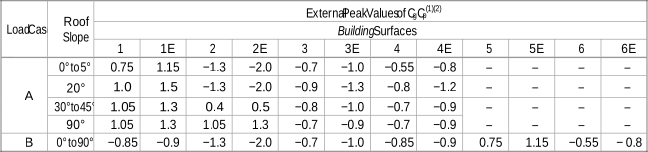
Notes to Table 4.1.7.6.:
(1) For values of roof slope not shown, the coefficient Cg Cp can be interpolated linearly.
(2) Positive coefficients denote forces toward the surface, whereas negative coefficients denote forces away from the surface.
(3)
For the design of individual walls and wall cladding, the values of Cg Cp are provided in Figure 4.1.7.6.-B.
(4)
For the design of roofs with a slope less than or equal to 7°, the values of Cg Cp are provided in Figure 4.1.7.6.-C.
(5)
For the design of flat roofs with steps in elevation, the values of Cg Cp are provided in Figure 4.1.7.6.-D.
(6)
For the design of gabled or hipped, single-ridge roofs with a slope greater than 7°, the values of Cg Cp are provided in Figure 4.1.7.6.-E.
(7)
For the design of gabled, multi-ridge roofs, the values of Cg Cp are provided in
(a)
Figure 4.1.7.6.-C for roofs with a slope less than or equal to 10°, and
(b)
Figure 4.1.7.6.-F for roofs with a slope greater than 10°.
(8)
For monosloped roofs, the values of Cg Cp are provided in
(a)
Figure 4.1.7.6.-C for roofs with a slope less than or equal to 3°, and
(b)
Figure 4.1.7.6.-G for roofs with a slope greater than 3° and less than or equal to 30°.
(9)
For sawtooth roofs, the values of Cg Cp are provided in
(a)
Figure 4.1.7.6.-C for roofs with a slope less than or equal to 10°, and
(b)
Figure 4.1.7.6.-H for roofs with a slope greater than 10°.
(10)
The wind loads on balcony guards on low buildings shall be as specified in Sentences 4.1.7.5.(5) and (6).
(11)
The wind loads on parapets on low buildings shall be as specified in Sentences 4.1.7.5.(7) to (9).
Figure 4.1.7.6.-A
Primary Structural Actions Arising from Wind Load Acting Simultaneously on All Surfaces of Low Buildings (H ≤ 20 m)
Forming Part of Sentence 4.1.7.6.(2) and Table 4.1.7.6.

Notes to Figure 4.1.7.6.-A:
(1) The building must be designed for all wind directions. Each corner must be considered in turn as the windward corner shown in the sketches. For all roof slopes, Load Case A and Load Case B are required as two separate loading conditions to generate the wind actions, including torsion, to be resisted by the structural system.
(2) For the design of foundations, exclusive of anchorages to the frame, only 70% of the effective load is to be considered.
(3) The reference height, h, for pressures is the mid-height of the roof or 6 m, whichever is greater. The eave height, H, may be substituted for the mid-height of the roof if the roof slope is less than 7°.
(4) End-zone width y should be the greater of 6 m or 2z, where z is the width of the gable-wall end zone defined for Load Case B below.
Alternatively, for buildings with frames, the end-zone width y may be the distance between the end and the first interior frame.
(5) End-zone width z is the lesser of 10% of the least horizontal dimension and 40% of height, H, but not less than 4% of the least horizontal dimension or 1 m.
(6) For B/H > 5 in Load Case A, the negative coefficients listed for surfaces 2 and 2E in Table 4.1.7.6. should only be applied on an area whose width is 2.5H measured from the windward eave. The pressures on the remainder of the windward roof should be reduced to the pressures for the leeward roof.
Figure 4.1.7.6.-B
External Peak Values of Cp Cg on Individual Walls for the Design of Cladding and Secondary Structural Members
Forming Part of Sentence 4.1.7.6.(3)

Notes to Figure 4.1.7.6.-B:
(1) These coefficients apply for any roof slope, α
(2) End-zone width z is the lesser of 10% of the least horizontal dimension and 40% of height, H, but not less than 4% of the least horizontal dimension or 1 m.
(3) Combinations of external and internal pressures must be evaluated to obtain the most severe loading.
(4) Positive coefficients denote forces toward the surface, whereas negative coefficients denote forces away from the surface. Each structural element must be designed to withstand forces of both signs.
(5) Pressure coefficients generally apply for facades with architectural features; however, where vertical ribs deeper than 1 m are placed on a facade, a local Cg Cp of –2.8 applies to zone e.
Figure 4.1.7.6.-C
External Peak Values of Cp Cg on Roofs with a Slope of 7º or Less for the Design of Structural Components and Cladding
Forming Part of Sentences 4.1.7.6.(4), (7), (8), and (9)

Notes to Figure 4.1.7.6.-C:
(1) Coefficients for overhung roofs have the prefix “o” and refer to the same roof areas as referred to by the corresponding symbol without a prefix. They include contributions from both upper and lower surfaces. In the case of overhangs, the walls are inboard of the roof outline.
(2) s and r apply to both roofs and upper surfaces of canopies.
(3) End-zone width z is the lesser of 10% of the least horizontal dimension and 40% of height, H, but not less than 4% of the least horizontal dimension or 1 m.
(4) Combinations of external and internal pressures must be evaluated to obtain the most severe loading.
(5) Positive coefficients denote forces toward the surface, whereas negative coefficients denote forces away from the surface. Each structural element must be designed to withstand forces of both signs.
(6) For calculating the uplift forces on tributary areas larger than 100 m
(7) For roofs having a perimeter parapet with a height of 1 m or greater, the corner coefficients Cg Cp for tributary areas less than 1 m
Figure 4.1.7.6.-D
External Peak Values of Cp Cg for the Design of the Structural Components and Cladding of Buildings with Stepped Roofs
Forming Part of Sentence 4.1.7.6.(5)

Notes to Figure 4.1.7.6.-D:
(1) The zone designations, pressure-gust coefficients and notes provided in Figure 4.1.7.6.-C apply on both the upper and lower levels of flat stepped roofs, except that on the lower levels, positive pressure-gust coefficients equal to those in Figure 4.1.7.6.-B for walls apply for a distance, b, where b is equal to 1.5h1 but not greater than 30 m. For all walls in Figure 4.1.7.6.-D, zone designations and pressure coefficients provided for walls in Figure 4.1.7.6.-B apply.
(2) Note (1) above applies only when the following conditions are met: h1 ≥ 0.3H, h1 ≥3 m, and W1, W
Figure 4.1.7.6.-E
External Peak Values of Cp Cg on Single-Span Gabled and Hipped Roofs with a Slope Greater than 7º for the Design of Structural Components and Cladding
Forming Part of Sentence 4.1.7.6.(6)

Notes to Figure 4.1.7.6.-E:
(1) Coefficients for overhung roofs have the prefix “o” and refer to the same roof areas as referred to by the corresponding symbol without a prefix. They include contributions from both upper and lower surfaces.
(2) End-zone width z is the lesser of 10% of the least horizontal dimension and 40% of height, H, but not less than 4% of the least horizontal dimension or 1 m.
(3) Combinations of external and internal pressures must be evaluated to obtain the most severe loading.
(4) Positive coefficients denote forces towards the surface, whereas negative coefficients denote forces away from the surface. Each structural element must be designed to withstand forces of both signs.
(5) For hipped roofs with 7° < α ≤ 27°, edge/ridge strips and pressure-gust coefficients for ridges of gabled roofs apply along each hip.
Figure 4.1.7.6.-F
External Peak Values of Cp Cg on Multi-Span Gabled (Folded) Roofs with a Slope Greater than 10º for the Design of Structural Components and Cladding
Forming Part of Sentence 4.1.7.6.(7)

Notes to Figure 4.1.7.6.-F:
(1) End-zone width z is the lesser of 10% of the least horizontal dimension and 40% of height, H, but not less than 4% of the least horizontal dimension or 1 m.
(2) Combinations of external and internal pressures must be evaluated to obtain the most severe loading.
(3) Positive coefficients denote forces towards the surface, whereas negative coefficients denote forces away from the surface. Each structural element must be designed to withstand forces of both signs.
(4) For α ≤ 10°, the coefficients given in Figure 4.1.7.6.-C apply, but for cases where α > than 7°, use α = 7°.
Figure 4.1.7.6.-G
External Peak Values of Cp Cg on Monoslope Roofs for the Design of Structural Components and Cladding
Forming Part of Sentence 4.1.7.6.(8)

Notes to Figure 4.1.7.6.-G:
(1) End-zone width, z, is the lesser of 10% of the least horizontal dimension and 40% of height, H, but not less than 4% of the least horizontal dimension or 1 m.
(2) Combinations of external and internal pressures shall be evaluated to obtain the most severe loading.
(3) Positive coefficients denote forces toward the surface, whereas negative coefficients denote forces away from the surface. Each structural element shall be designed to withstand forces of both signs.
(4) Where α ≤ 3°, the coefficients given in Figure 4.1.7.6.-C apply.
Figure 4.1.7.6.-H
External Peak Values of Cp Cg on Sawtooth Roofs with a Slope Greater than 10˚ for the Design of Structural Components and Cladding
Forming Part of Sentence 4.1.7.6.(9)

Notes to Figure 4.1.7.6.-H:
(1) End-zone width z is the lesser of 10% of the least horizontal dimension and 40% of height, H, but not less than 4% of the least horizontal dimension or 1 m.
(2) Combinations of external and internal pressures must be evaluated to obtain the most severe loading.
(3) Positive coefficients denote forces towards the surface, whereas negative coefficients denote forces away from the surface. Each structural element must be designed to withstand forces of both signs.
(4) Negative coefficients on the corner zones of Span A differ from those on Spans B, C and D.
(5) For α ≤ 10°, the coefficients given in Figure 4.1.7.6.-C apply, but for cases where α > than 7°, use α = 7°.