(See Note A-9.32.3.4.)
(1)
Where outdoor air is to be introduced to the dwelling unit through a forced air heating system, the provision of outdoor air shall comply with this Article.
(2)
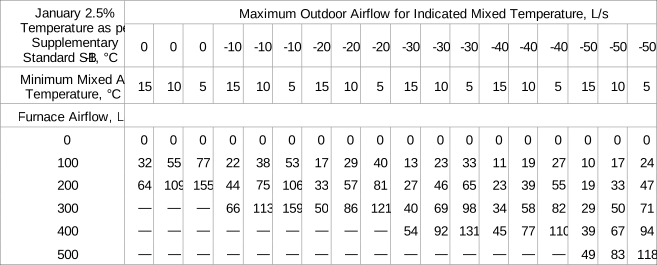
Where the actual normal operating exhaust capacity of the fan installed to satisfy the requirement for a principal ventilation fan exceeds the maximum outdoor airflow permitted by Table 9.32.3.4. for a mixed air temperature of 15°C or exceeds the minimum acceptable return air temperature specified by the manufacturer of the furnace, whichever is less, then either
(a)
the system shall incorporate a means for tempering outdoor air introduced to the heating system ducts so that a mixed air temperature of 15°C or the minimum acceptable return air temperature specified by the manufacturer of the furnace, whichever is less, is achieved when the outdoor air is at the January 2.5% temperature and the indoor air temperature is 22°C, or
(b)
this Article shall be considered to be no longer applicable and the mechanical ventilation system shall comply with either Clause 9.32.3.1.(1)(a) or with Article 9.32.3.5.
(3)
For the purposes of Table 9.32.3.4., the furnace airflow shall be determined
(a)
by operating the forced air heating system’s circulation fan at the rate chosen to satisfy Clause (9)(a) when measuring the return airflow in the furnace return air plenum immediately upstream of the connection of the outdoor air supply duct required by Sentence (5) and then adding this return airflow measurement to the actual normal operating exhaust capacity of the fan installed to satisfy the requirement for a principal ventilation fan, or
(b)
by using the manufacturer’s rated flow for the furnace for 150 Pa static pressure and the wiring configuration necessary to achieve the flow specified in Clause (9)(a).
Table 9.32.3.4.
Maximum Outdoor Airflow
Forming Part of Sentence 9.32.3.4.(2)
(4)
Linear interpolation is permitted in using Table 9.32.3.4.
(5)
An outdoor air supply duct shall be installed between the outdoors and the furnace return air plenum and shall be connected
(a)
not less than 3 m upstream of the plenum connection to the furnace, as measured along the length of the duct, or
(b)
through an acceptable mixing device installed in the return air plenum.
(6)
The outdoor air supply duct required by Sentence (5) shall incorporate a flow-regulating damper.
(7)
Where the outdoor air supply duct required by Sentence (5) is not connected to an outdoor air supply fan, it shall be connected downstream of all return branch connections.
(8)
Where the outdoor air supply duct required by Sentence (5) is connected to an auxiliary outdoor air supply fan, the auxiliary outdoor air supply fan shall be
(a)
approved by the manufacturer for the handling of untempered outdoor air if it will be handling untempered outdoor air,
(b)
approved by the manufacturer for continuous operation, and
(c)
designed to provide an outdoor air supply flow within ±10% of the actual normal operating exhaust capacity of the exhaust fan installed to satisfy the requirement for a principal ventilation fan.
(9)
The principal ventilation fan control required by Sentence 9.32.3.3.(5) shall be wired in such a way that
(a)
activation of the principal ventilation fan automatically activates the forced air heating system’s circulation fan to provide an airflow not greater than the space-heating airflow,
(b)
where applicable, activation of the principal ventilation fan automatically activates the auxiliary outdoor air supply fan described in Sentence (8), and
(c)
the auxiliary outdoor air supply fan does not operate when the principal ventilation fan is not operating.
(10)
With the principal ventilation fan operating at its normal operating exhaust capacity, the airflow in the outdoor air supply duct shall be measured and the flow-regulating damper required by Sentence (6) shall be adjusted and permanently fixed so that the airflow in the outdoor air supply duct is within ±10% of the actual normal operating exhaust capacity of the principal ventilation fan.