(See Note A-9.32.3.11.)
(1)
Except as provided in Sentence (6), ventilation ducts and their fittings shall conform to the requirements of Article 9.33.6.2., except that exhaust ducts serving only a bathroom or water-closet room are permitted to be of combustible material, provided they are reasonably airtight and constructed of a material impervious to water.
(2)
Exhaust ducts shall not discharge into heated or unheated enclosed spaces.
(3)
Where an exhaust duct passes through an unheated space or is not separated from an unheated space by an insulated building assembly, the duct shall be insulated to not less than RSI 0.5.
(4)
Where a duct carrying outdoor air that is not tempered and not mixed with indoor air passes through heated space, it shall be
(a)
insulated to not less than RSI 0.5, and
(b)
provided with a vapour barrier.
(5)
All exhaust intakes located within 3 m horizontally of a cooktop shall be equipped with a grease filter at the intake end.
(6)
Ductwork for cooking appliance exhaust fans shall
(a)
be of noncombustible, corrosion-resistant material,
(b)
lead directly to the outdoors with no connections to other exhaust fans or ducts, and
(c)
be equipped with a grease filter at the intake end.
(7)
All ductwork shall be installed to avoid crushing and shall be permanently supported to prevent sagging.
(8)
Joints in all ventilation system ducting shall be sealed with mastic, metal foil duct tape or the manufacturers’ specified sealants.
(9)
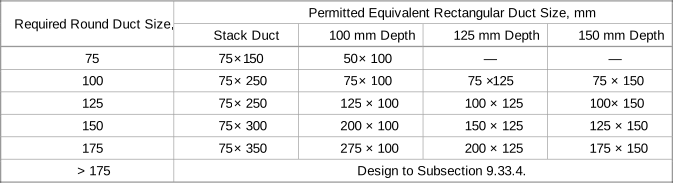
Except where the size of a duct can be determined using Table 9.32.3.11.-A or Table 9.32.3.11.-B, duct sizes shall be determined according to Subsection 9.33.4.
(10)
In using Table 9.32.3.11.-A,
(a)
when sizing branch ducts, “maximum length of duct” refers to the physical length of the duct from the interior grille served by that branch duct to the exterior hood,
(b)
when sizing a trunk duct, “maximum length of duct” refers to the physical length of the duct from the interior grille of the longest branch served by that trunk to the exterior hood,
(c)
outdoor air supply ducts shall be sized as trunk ducts,
(d)
“maximum airflow in duct” refers to the maximum airflow rate that a given section of duct (branch or trunk) must provide to satisfy the ventilation system design, and
(e)
“fan’s external static pressure” refers to the external static pressure at which the fan is rated to achieve the maximum airflow rate that the fan is required or intended to provide.
(11)
Where flexible duct is used, it may be sized by choosing the next higher diameter in Table 9.32.3.11.-A or by choosing the diameter for a duct twice as long as the actual length. ( 12) Where rectangular duct is used in place of round duct, it shall be selected according to Table 9.32.3.11.-B.
Table 9.32.3.11.-A
Equivalent Duct Sizes
Forming Part of Sentence 9.32.3.11.(9)
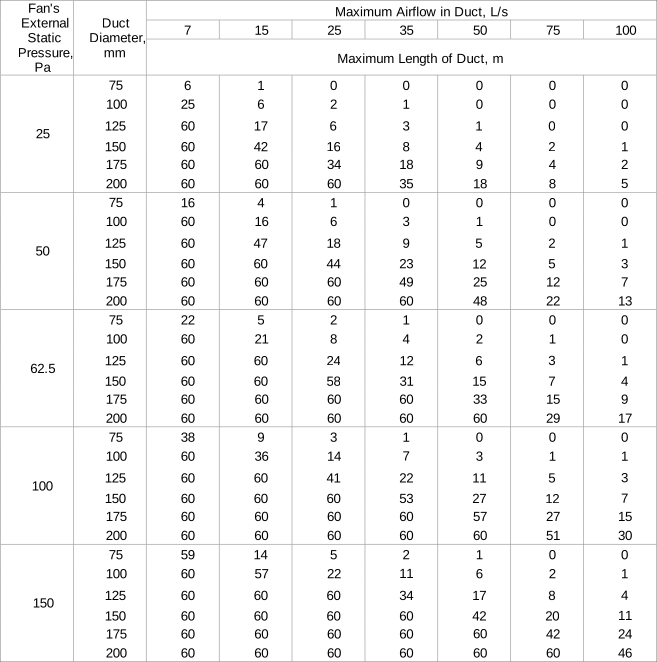
Table 9.32.3.11.-B
Equivalent Duct Sizes
Forming Part of Sentences 9.32.3.11.(9) and (12)