(1)
Except as provided in Sentence (4), roof rafters and joists shall be supported at the ridge of the roof by
(a)
a loadbearing wall extending from the ridge to suitable bearing, or
(b)
a ridge beam supported by not less than 89 mm length of bearing.
(2)
Except as provided in Sentence (3), the ridge beam referred to in Sentence (1) shall conform to the sizes and spans shown in Span Table 9.23.4.2.-L, provided
(a)
the supported rafter or joist length does not exceed 4.9 m, and
(b)
the roof does not support any concentrated loads.
(a)
the beam is of not less than 38 mm by 140 mm material, and
(b)
the beam is supported at intervals not exceeding 1.2 m by not less than 38 mm by 89 mm members extending vertically from the ridge to suitable bearing.
(4)
When the roof slope is 1 in 3 or steeper, ridge support need not be provided when the lower ends of the rafters are adequately tied to prevent outward movement.
(5)
Ties required in Sentence (4) are permitted to consist of tie rods or ceiling joists forming a continuous tie for opposing rafters and nailed in accordance with Table 9.23.14.8.
(6)
Except as permitted in Sentence (7), ceiling joists referred to in Sentence (5) shall be tied to the base of every rafter.
(7)
Where ceiling joists referred to in Sentence (5) are raised above the base of the rafters, the connections between the rafters and the ceiling joists shall be designed in accordance with Clause 9.4.1.1.(1)(b) or (c).
(8)
Ceiling joists referred to in Sentence (5) that are spliced to make a continuous joist shall be fastened together at each splice with at least one more nail than required for the rafter-to-joist connection shown in Table 9.23.14.8.
(9)
Members referred to in Sentences (6) and (8) are permitted to be fastened together either directly or through a gusset plate.
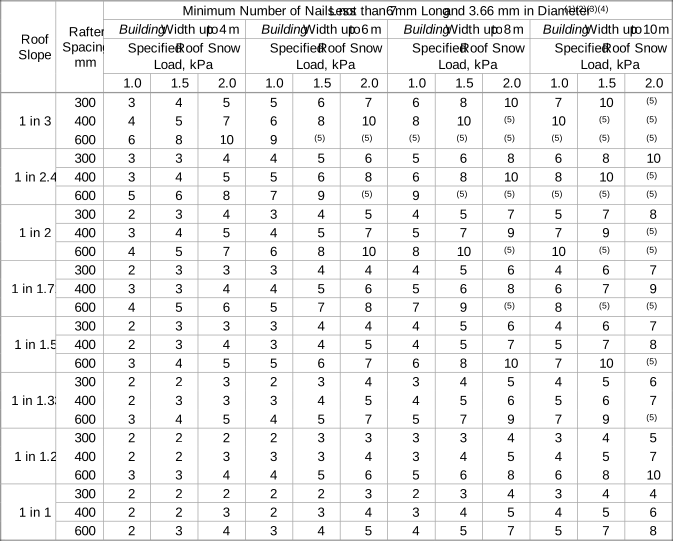
Table 9.23.14.8.
Rafter-to-Joist Nailing (Unsupported Ridge)
Forming Part of Sentences 9.23.14.8.(5) and (8)
Notes to Table 9.23.14.8.:
(1) Nails with a diameter less than 3.66 mm are permitted to be used, provided the minimum number of nails stated in the Table is modified as follows: • For a nail diameter greater than or equal to 2.86 mm and less than 3.25 mm, add 3 nails to the minimum number of nails, up to a maximum of 10 nails. • For a nail diameter greater than or equal to 3.25 mm and less than 3.66 mm, add 2 nails to the minimum number of nails, up to a maximum of 10 nails.
Where more than 10 nails are required, the connections between the rafters and the ceiling joists shall be designed in accordance with Clause 9.4.1.1.(1)(b) or (c).
(2) The minimum number of nails stated in the Table is applicable to Spruce-Pine-Fir, Douglas Fir-Larch and Hem-Fir members. For Northern Species members, add 2 nails to the minimum number of nails, up to a maximum of 10 nails. Where more than 10 nails are required, the connections between the rafters and the ceiling joists shall be designed in accordance with Clause 9.4.1.1.(1)(b) or (c).
(3) To accommodate nail spacing, not less than 38 mm × 140 mm joists shall be used where 6 or more nails are required, and not less than 38 mm × 184 mm joists shall be used where 8 or more nails are required.
(4) The minimum number of nails in the Table is applicable for a maximum roof dead load of 0.5 kPa.
(5) The connections between the rafters and the ceiling joists shall be designed in accordance with Clause 9.4.1.1.(1)(b) or (c).