(1)
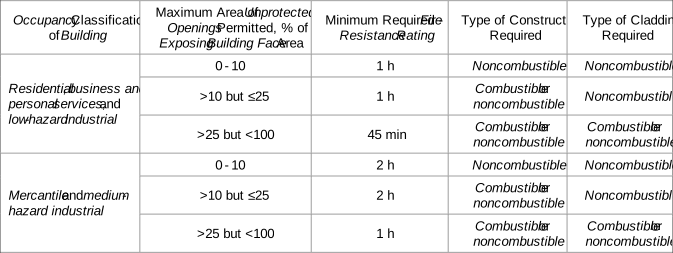
Except as provided in Sentences (4) to (14), each exposing building face and any exterior wall located above an exposing building face that encloses an attic or roof space shall be constructed in conformance with Table 9.10.14.5. and Subsection 9.10.8.
(See Note A-9.10.14.5.(1))
(2)
Cladding on exposing building faces and exterior walls located above exposing building faces need not conform to the type of cladding required by Table 9.10.14.5. where
(a)
the exposing building face is constructed with no unprotected openings,
(b)
the limiting distance is not less than 0.6 m, and
(c)
the cladding
(i)
conforms to Subsection 9.27.12.,
(ii)
is installed without furring members over not less than 12.7 mm thick gypsum sheathing or over masonry,
(iii)
has a flame-spread rating not more than 25 when tested in accordance with Sentence 3.1.12.1.(2), and
(iv)
is not more than 2 mm in thickness exclusive of fasteners, joints and local reinforcements.
Table 9.10.14.5.
Minimum Construction Requirements for Exposing Building Faces
Forming Part of Sentence 9.10.14.5.(1)
(3)
Reserved.
(4)
Except as provided in Sentence (5), where a garage or accessory building serves one dwelling unit only and is detached from any building, the exposing building face
(a)
need not conform to the minimum required fire-resistance rating stated in Table 9.10.14.5., where the limiting distance is 0.6 m or more,
(b)
shall have a fire-resistance rating of not less than 45 min where the limiting distance is less than 0.6 m, and
(c)
need not conform to the type of cladding and type of construction required by Table 9.10.14.5., regardless of the limiting distance.
(5)
The requirements regarding fire-resistance rating, type of construction and type of cladding need not apply to the exposing building face of a detached garage or accessory building facing a dwelling unit, where
(a)
the detached garage or accessory building serves only one dwelling unit,
(b)
the detached garage or accessory building is located on the same property as that dwelling unit, and
(c)
the dwelling unit served by the detached garage or accessory building is the only major occupancy on the property.
(6)
Except for buildings containing one or two dwelling units only , combustible projections on the exterior of a wall that are more than 1 m above ground level and that could expose an adjacent building to fire spread shall not be permitted within
(a)
1.2 m of a property line or the centre line of a public way, or
(b)
2.4 m of a combustible projection on another building on the same property.
(7)
Reserved.
(8)
Reserved.
(9)
Reserved.
(10)
Reserved.
(11)
Reserved.
(12)
Where roof soffits project to less than 1.2 m from the property line, the centre line of a public way, or an imaginary line between two buildings or fire compartments on the same property, they shall
(a)
have no openings, and
(b)
be protected by
(i)
not less than 0.38 mm thick sheet steel,
(ii)
unvented aluminum conforming to CAN/CGSB-93.2-M, “Prefinished Aluminum Siding, Soffits, and Fascia, for Residential Use,”
(iii)
not less than 12.7 mm thick gypsum soffit board or gypsum ceiling board installed according to CSA A82.31-M, “Gypsum Board Application,”
(iv)
not less than 11 mm thick plywood,
(v)
not less than 12.5 mm thick OSB or waferboard, or
(13)
Heavy timber and steel columns need not conform to the requirements of Sentence (1) provided the limiting distance is not less than 3 m.
(14)
Non- loadbearing wall components need not have a minimum fire-resistance rating, where the building
(a)
is 1 storey in building height,
(b)
is of noncombustible construction,
(c)
is classified as low-hazard industrial occupancy and is used only for low fire load occupancies such as power generating plants or plants for the manufacture or storage of noncombustible materials, and
(d)
has a limiting distance of 3 m or more.