(See Note A-4.1.8.18.)
(1)
Except as provided in Sentences (2), (7) and (16), elements and components of buildings described in Table 4.1.8.18. and their connections to the structure shall be designed to accommodate the building deflections calculated in accordance with Article 4.1.8.13. and the element or component deflections calculated in accordance with Sentence (9), and shall be designed for a specified lateral earthquake force, Vp, distributed according to the distribution of mass:

(2)
For buildings in Seismic Category SC1 or SC2, other than post-disaster buildings, seismically isolated buildings, and buildings with supplemental energy dissipation systems, the requirements of Sentence (1) need not apply to Categories 6 through 22 of Table 4.1.8.18.
(3)
For the purpose of applying Sentence (1) for Categories 11 and 12 of Table 4.1.8.18., elements or components shall be assumed to be flexible or flexibly connected unless it can be shown that the fundamental period of the element or component and its connection is less than or equal to 0.06 s, in which case the element or component is classified as being rigid and rigidly connected.
(4)
The weight of access floors shall include the dead load of the access floor and the weight of permanent equipment, which shall not be taken as less than 25% of the floor live load.
(5)
When the mass of a tank plus its contents or the mass of a flexible or flexibly connected piece of machinery, fixture or equipment is greater than 10% of the mass of the supporting floor, the lateral forces shall be determined by rational analysis.
(6)
Forces shall be applied in the horizontal direction that results in the most critical loading for design, except for Category 6 of Table 4.1.8.18., where the forces shall be applied up and down vertically.
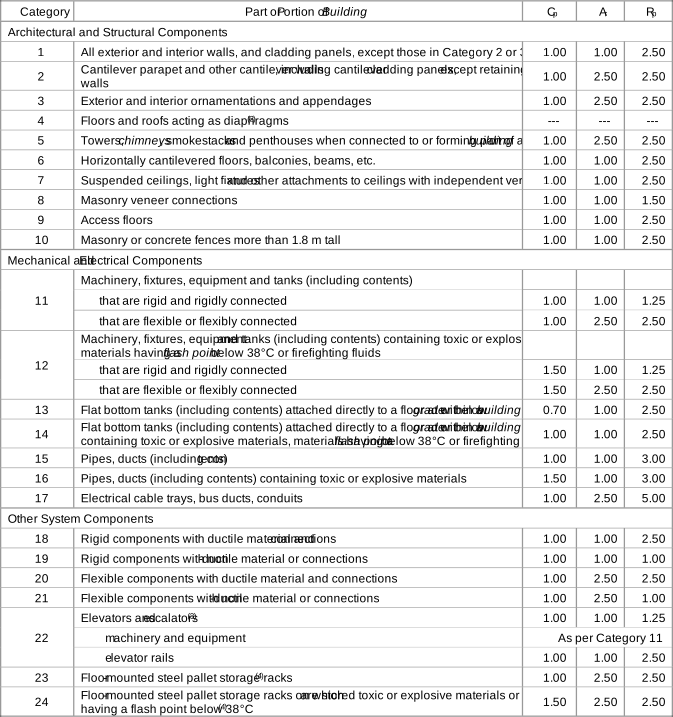
Table 4.1.8.18.
Elements of Structures and Non-Structural Components and Equipment
Forming Part of Sentences 4.1.8.18.(1) to (3), (6), (7) and (16), and Clauses 4.1.8.23.(2)(c) and (3)(c)
Notes to Table 4.1.8.18.:
(1) See Note A-Table 4.1.8.18.
(2) See Sentence (8).
(3) See also ASME A17.1 / CSA B44, “Safety Code for Elevators and Escalators.”
(4) See Sentence (13) and Note A-Table 4.1.8.18.
(7)
Connections to the structure of elements and components listed in Table 4.1.8.18. shall be designed to support the component or element for gravity loads, shall conform to the requirements of Sentence (1), and shall also satisfy these additional requirements:
(a)
except as provided in Sentence (17), friction due to gravity loads shall not be considered to provide resistance to earthquake forces,
(b)
Rp for non-ductile connections, such as adhesives or power-actuated fasteners, shall be taken as 1.0,
(c)
Rp for shallow post-installed mechanical, post-installed adhesive, and cast-in-place anchors in concrete shall be 1.5, where shallow anchors are those with a ratio of embedment length to diameter of less than 8,
(d)
post-installed mechanical, drop-in and adhesive anchors in concrete shall be pre-qualified for seismic applications by cyclic load testing in accordance with
(i)
CSA A23.3, “Design of concrete structures,” and
(ii)
ACI 355.2, “Qualification of Post-Installed Mechanical Anchors in Concrete (ACI 355.2-19) and Commentary,” or ACI 355.4, “Qualification of Post-Installed Adhesive Anchors in Concrete (ACI 355.4-19) and Commentary,” as applicable,
(e)
post-installed mechanical and adhesive anchors in masonry and post-installed mechanical anchors in structural steel shall be pre-qualified for seismic applications by cyclic tension load testing,
(See Note [b-4.1.8.18.-appx|A-4.1.8.18.](e))
(f)
power-actuated fasteners shall not be used for cyclic tension loads,
(g)
connections for non-structural elements or components of Category 1, 2 or 3 of Table 4.1.8.18. attached to the side of a building and above the first level above grade shall satisfy the following requirements:
(i)
for connections where the body of the connection is ductile, the body shall be designed for values of Cp, Ar and Rp given in Table 4.1.8.18., and all of the other parts of the connection, such as anchors, welds, bolts and inserts, shall be capable of developing 2.0 times the nominal yield resistance of the body of the connection, and
(ii)
connections where the body of the connection is not ductile shall be designed for values of Cp = 2.0, Rp = 1.0 and Ar given in Table 4.1.8.18., and
(h)
a ductile connection is one where the body of the connection is capable of dissipating energy through cyclic inelastic behaviour.
(8)
Floors and roofs acting as diaphragms shall satisfy the requirements for diaphragms stated in Article 4.1.8.15.
(9)
Lateral deflections of elements or components shall be based on the loads defined in Sentence (1) and lateral deflections obtained from an elastic analysis shall be multiplied by Rp /IE to give realistic values of the anticipated deflections.
(10)
The elements or components shall be designed so as not to transfer to the structure any forces unaccounted for in the design, and rigid elements such as walls or panels shall satisfy the requirements of Sentence 4.1.8.3.(6).
(11)
Seismic restraint for suspended equipment, pipes, ducts, electrical cable trays, etc. shall be designed to meet the force and displacement requirements of this Article and be constructed in a manner that will not subject hanger rods to bending.
(12)
Isolated suspended equipment and components, such as pendent lights, may be designed as a pendulum system provided that adequate chains or cables capable of supporting 2.0 times the weight of the suspended component are provided and the deflection requirements of Sentence (10) are satisfied.
(13)
Free-standing steel pallet storage racks are permitted to be designed to resist earthquake effects using rational analysis, provided the design achieves the minimum performance level required by Subsection 4.1.8.
(See Note A-4.1.8.18.(13) and 4.4.3.1.(1).)
(14)
Except as provided in Sentence (15), the relative displacement of glass in glazing systems, Dfallout, shall be equal to the greater of
(a)
Dfallout ≥ 1.25IE Dp, where Dfallout = relative displacement at which glass fallout occurs, and Dp = relative earthquake displacement that the component must be designed to accommodate, calculated in accordance with Article 4.1.8.13. and applied over the height of the glass component, or
(15)
Glass need not comply with Sentence (14), provided at least one of the following conditions is met:
(a)
the Seismic Category is SC1 or SC2,
(b)
the glass has sufficient clearance from its frame such that Dclear ≥ 1.25Dp calculated as follows:

(c)
the glass is fully tempered, monolithic, installed in a non- post-disaster building, and no part of the glass is located more than 3 m above a walking surface, or
(d)
the glass is annealed or heat-strengthened laminated glass in a single thickness with an interlayer no less than 0.76 mm and captured mechanically in a wall system glazing pocket with the perimeter secured to the frame by a wet, glazed, gunable, curing, elastomeric sealant perimeter bead of 13 mm minimum glass contact width.
(See Note A-4.1.8.18.(14) and (15))
(16)
For structures with supplemental energy dissipation, elements and components of buildings described in Table 4.1.8.18. and their connections to the structure shall be designed for a specified lateral earthquake force, Vp, determined at each floor level as follows:

(See Note [b-4.1.8.18.-appx|A-4.1.8.18.])
(17)
For a ballasted array of interconnected solar panels mounted on a roof, where IE S(0.2) is less than or equal to 1.0, friction due to gravity loads is permitted to be considered to provide resistance to seismic forces, provided
(a)
the roof is not normally occupied,
(b)
the roof is surrounded by a parapet extending from the roof surface to not less than the greater of
(i)
150 mm above the centre of mass of the array, and
(ii)
400 mm above the roof surface,
(c)
the height of the centre of mass of the array above the roof surface is less than the lesser of
(i)
900 mm, and
(ii)
one half of the smallest plan dimension of the supporting base of the array,
(d)
the roof slope at the location of the array is less than or equal to 3°,
(e)
the factored friction resistance calculated using the kinetic friction coefficient determined in accordance with Sentence (18) and a resistance factor of 0.7 is greater than or equal to the specified lateral earthquake force, Vp, on the array determined in accordance with Sentence (1) using values of Ar = 1.0, Ax = 3.0, Cp = 1.0, and Rp = 1.25,
(f)
the minimum clearance between the array and other arrays or fixed objects is the greater of
(i)
225 mm, and
(ii)
1 500(IE S(0.2) − 0.4)
(g)
the minimum clearance between the array and the roof parapet is the greater of
(i)
450 mm, and
(ii)
3 000(IE S(0.2) − 0.4)
(18)
For the purpose of Clause (17)(e), the kinetic friction coefficient shall be determined in accordance with ASTM G115, “Standard Guide for Measuring and Reporting Friction Coefficients,” through experimental testing that
(a)
is carried out by an accredited laboratory on a full-scale array or a prototype of the array,
(b)
models the interface between the supporting base of the array and the roof surface, and
(c)
accounts for the adverse effects of anticipated climatic conditions on the friction resistance.
(See Note [b-4.1.8.18.-appx|A-4.1.8.18.])