(1)
The static loading due to earthquake motion shall be determined according to the procedures given in this Article.
(2)
Except as provided in Sentence (12), the specified lateral earthquake force, V, shall be calculated using the following formula: V = S (Ta) Mv IE W/ (Rd Ro) except,
(a)
for walls, coupled walls and wall-frame systems, V shall not be less than, S (4.0) Mv IE W/ (Rd Ro)
(b)
for moment-resisting frames, braced frames and other systems, V shall not be less than, S (2.0) Mv IE W/ (Rd Ro), and
(c)
for buildings located on a site designated as other than XF and having an SFRS with an Rd equal to or greater than 1.5, V need not be greater than the larger of (2/3) S (0.2) IE W / (Rd Ro), and S (0.5) IE W / (Rd Ro)
(3)
Except as provided in Sentence (4), the fundamental lateral period, Ta, in the direction under consideration in Sentence (2) shall be determined as:
(a)
for moment-resisting frames that resist 100% of the lateral earthquake forces and where the frame is not enclosed by or adjoined by more rigid elements that would tend to prevent the frame from resisting lateral forces, and where hn is in metres:
(i)
0.085(hn)3/4 for steel moment frames,
(ii)
0.075(hn)3/4 for concrete moment frames, or
(iii)
0.1N for other moment frames,
(b)
0.025hn for braced frames,
(c)
0.05(hn)3/4 for shear wall and other structures, or
(d)
other established methods of mechanics using a structural model that complies with the requirements of Sentence 4.1.8.3.(8), except that
(i)
for moment-resisting frames, Ta shall not be taken as greater than 1.5 times that determined in Clause (a),
(ii)
for braced frames, Ta shall not be taken as greater than 2.0 times that determined in Clause (b),
(iii)
for shear wall structures, Ta shall not be taken as greater than 2.0 times that determined in Clause (c),
(iv)
for other structures, Ta shall not be taken as greater than that determined in Clause (c), and
(v)
for the purpose of calculating the deflections, the period without the upper limit specified in Subclauses (d)(i) to (d)(iv) may be used, except that, for walls, coupled walls and wall-frame systems, Ta shall not exceed 4.0 s, and for moment-resisting frames, braced frames, and other systems, Ta shall not exceed 2.0 s.
(See Note A-4.1.8.11.(3))
(4)
For single- storey buildings with steel deck or wood roof diaphragms, the fundamental lateral period, Ta, in the direction under consideration is permitted to be taken as,
(a)
0.05(hn)3/4 + 0.004L for shear walls,
(b)
0.035hn + 0.004L for steel moment frames and steel braced frames, or
(c)
the value obtained from methods of mechanics using a structural model that complies with the requirements of Sentence 4.1.8.3.(8), except that Ta shall not be greater than 1.5 times the value determined in Clause (a) or (b), as applicable, where L is the shortest length of the diaphragm, in m, between adjacent vertical elements of the SFRS in the direction perpendicular to the direction under consideration.
(5)
The weight, W, of the building shall be calculated using the following formula:
(6)
The higher mode factor, Mv, and its associated base overturning moment reduction factor, J, shall conform to Table 4.1.8.11.
(7)
The specified lateral earthquake force, V, shall be distributed such that
(a)
a portion, Ft, is concentrated at the top of the building, where Ft is equal to 0.07Ta V but need not exceed 0.25V and may be considered as zero where the fundamental lateral period, Ta, does not exceed 0.7 s, and
(b)
the remainder, V − Ft, is distributed along the height of the building, including the top level, in accordance with the following formula: Fx = (V – Ft) Wx hx /
Table 4.1.8.11.
Higher Mode Factor, Mv, and Base Overturning Reduction Factor, J
Forming Part of Sentence 4.1.8.11.(6)
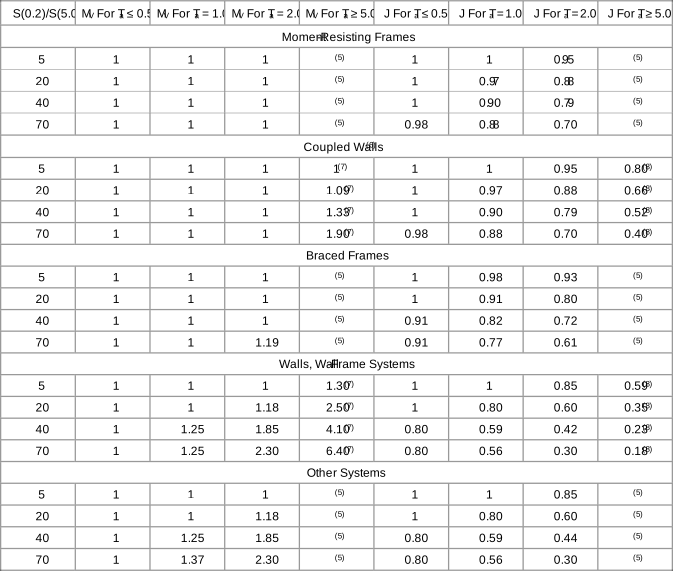
Notes to Table 4.1.8.11.:
(1) For intermediate values of the spectral ratio S(0.2)/S(5.0), Mv and J shall be obtained by linear interpolation. For spectral ratios less than 5, Mv and J shall be obtained by linear interpolation with their values at a spectral ratio of 0 taken as equal to 1. For spectral ratios greater than 70, Mv and J shall be taken as equal to their values at a spectral ratio of 70.
(2) For intermediate values of the fundamental lateral period, Ta, in cases where S(Ta) is obtained by log–log interpolation, Mv shall be obtained by linear interpolation using the values of Mv obtained in accordance with Note (1). In cases where S(Ta) is obtained by linear interpolation, the product S(Ta)Mv shall be obtained by linear interpolation using the values of Mv obtained in accordance with Note (1).
(3) For intermediate values of the fundamental lateral period, Ta, J shall be obtained by linear interpolation using the values of J obtained in accordance with Note (1).
(4) For a combination of different SFRSs not given in Table 4.1.8.11. that are in the same direction under consideration, use the highest Mv factor of all the SFRSs and the corresponding value of J.
Notes to Table 4.1.8.11.: (Cont’d)
(5) For fundamental lateral periods, Ta, greater than 2.0 s, use the 2.0 s values obtained in accordance with Note (1). See Clause 4.1.8.11.(2)(b).
(6) A “coupled” wall is a wall system with coupling beams, where at least 66% of the base overturning moment resisted by the wall system is carried by the axial tension and compression forces resulting from shear in the coupling beams.
(7) For fundamental lateral periods, Ta, greater than 4.0 s, use the 4.0 s values of S(Ta)Mv obtained by interpolation between 2.0 s and 5.0 s using the value of Mv obtained in accordance with Note (1). See Clause 4.1.8.11.(2)(a).
(8) For fundamental lateral periods, Ta, greater than 4.0 s, use the 4.0 s values of J obtained by interpolation between 2.0 s and 5.0 s using the value of J obtained in accordance with Note (1). See Clause 4.1.8.11.(2)(a). (8) The structure shall be designed to resist overturning effects caused by the earthquake forces determined in Sentence (7) and the overturning moment at level x, Mx, shall be determined using the following equation: (hi – hx) where, Jx = 1.0 for hx ≥ 0.6hn, and Jx = J + (1- J)(hx / 0.6hn) for hx, < 0.6hn where, J = base overturning moment reduction factor conforming to Table 4.1.8.11.
(9)
Torsional effects that are concurrent with the effects of the forces determined in Sentence (7) and are caused by the simultaneous actions of the following torsional moments shall be considered in the design of the structure according to Sentence (11):
(a)
torsional moments introduced by eccentricity between the centres of mass and resistance and their dynamic amplification, and
(b)
torsional moments due to accidental eccentricities.
(10)
Torsional sensitivity shall be determined by calculating the ratio Bx for each level x according to the following equation for each orthogonal direction determined independently: Bx = δmax / δave where, B = maximum of all values of Bx in both orthogonal directions, except that the Bx for one- storey penthouses with a weight less than 10% of the level below need not be considered, δmax = maximum storey displacement at the extreme points of the structure at level x in the direction of the earthquake induced by the forces determined in Sentence (7) acting at distances ± 0.10 Dnx from the centres of mass at each floor, and δave = average of the displacements at the extreme points of the structure at level x produced by the forces determined in Sentence (7).
(11)
Torsional effects shall be accounted for as follows:
(a)
for a building with B ≤ 1.7 or in Seismic Category SC1 or SC2, by applying torsional moments about a vertical axis at each level throughout the building, derived for each of the following load cases considered separately:
(i)
Tx = Fx (ex + 0.10 Dnx), and
(ii)
Tx = Fx (ex – 0.10 Dnx) where Fx is determined in accordance with Sentence (7) and where each element of the building is designed for the most severe effect of the above load cases, or
(b)
for a building with B > 1.7 in Seismic Category SC3 or SC4, by a Dynamic Analysis Procedure as specified in Article 4.1.8.12.
(12)
Where the fundamental lateral period, Ta, is determined in accordance with Clause (3)(d) and the building is constructed with more than 4 storeys of continuous wood construction and has a timber SFRS consisting of shear walls with wood-based panels or of braced or moment-resisting frames as defined in Table 4.1.8.9., the specified lateral earthquake force, V, as determined in Sentence (2) shall be multiplied by 1.2 but need not exceed the value determined by using Clause (2)(c).
(See Note A-4.1.8.10.(5) and (6))